.png)

Vision Therapy
Vision therapy is a treatment program designed to correct and/or improve specific dysfunctions of a patient's visual system.
Under the supervision of a vision care professional specializing in developmental optometry, a treatment plan is developed and customized based on an individual's specific needs.
What is Vision Therapy?
Vision therapy is a treatment program designed to correct and/or improve specific dysfunctions of a patient's visual system.
Under the supervision of a vision care professional specializing in developmental optometry, a treatment plan is developed and customized based on an individual's specific needs.
A variety of specialized equipment is used, and the program is followed both in the office and with home activities, with routine evaluations to track the patient's progress.
*Assessment and therapy programs will vary depending on the vision conditions being treated

-
Skips or repeats lines while reading
-
Poor reading comprehension
-
Near work takes a long time
-
Reverse letters like “b” into “d”
-
Short attention span with near work
-
.jpeg)
Anyone experiencing:
-
Poor ability to track and fixate on objects
-
Poor attention span and concentration
-
Difficulty focusing both eyes together
-
Lazy eye/Strabismus
-
Headache/Dizziness/Nausea while focusing
-
Inconsistent performance in sports
-
Poor depth perception
-
Reversal of letters, words, or directions
-
Difficulty copying from a board
-
Concussion
-
Traumatic Brain Injury
-
Vision-Related Learning Problems
-
.jpeg)
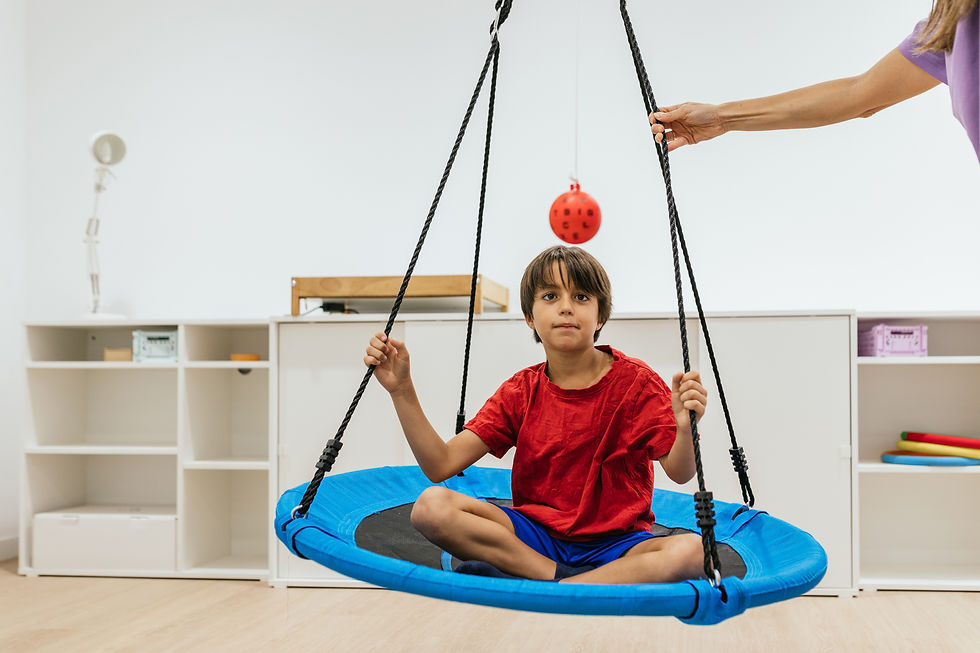
Vision Therapy is conducted in-office once or twice a week for 45 minutes; at-home therapy is also assigned on a daily basis.
Our weekly clinic sessions involve different eye exercises with various types of lenses, prisms, filters, and patches to help further develop fundamental visual skills.
The goal is to improve visual comfort and promote visual processing.
Depending on the severity of the visual condition and the patient's needs and goals; the duration of the program is typically 24-36 sessions.
During the therapy program, a progress evaluation will be completed between sessions. This will help track the level of improvement so we can maintain an effective therapy plan.
After completion of the program, maintenance home therapy exercises will be assigned. The patient will be scheduled for a 3 to 6-month post-therapy follow-up evaluation to ensure that the improvements made through the program are maintained.

After a neurological impairment such as a head injury, stroke, or other neurological conditions, patients suffer from a neural disconnect between vision, balance and sensory processing. Due to poor integration of vision, balance, and sensory processing, simple daily tasks such as reading, writing, speaking, and balance are affected. These patients often suffer from constant headaches, light sensitivity, poor concentration, spatial disorientation, and blurred or double vision.
Our neuro-optometric rehabilitation program is an individualized patient treatment regimen to help improve patients’ vision, body movement, coordination, and sensory processing to be more balanced and more effectively integrated to overcome their overall visual deficiency.

-
Headaches
-
Light sensitivity
-
Blurred/ Double vision
-
Dizziness and Vertigo
-
Eye fatigue
-
Poor Concentration and Memory
-
Poor eye movement and control
-
Recent onset of the eye turns (ie. IN/OUT/UP/DOWN)
-
Unstable peripheral vision
-
Poor balance
-
Mood changes
-
Sleeping problem
-
MIND-BODY - ACTION LIFE CHANGE
The visual system plays an important role in the input and output of information to the brain. Therefore, early remediation of the visual deficiencies will speed up the recovery of total visual function as well as improve patients’ quality of life.